
SMIRLY Acacia Wood Set Reviewed
Let’s get straight to the question every home cook asks at some point: What is the best chopping board for meat and chicken?
The honest answer depends on what you actually need from a cutting board — not just the material, but the size, the stability, the cleanup routine, and whether it fits how your kitchen actually works day to day. A board that’s perfect for a minimalist apartment kitchen might be completely wrong for a busy family household that preps multiple proteins every night.
That said, after comparing dozens of options across plastic, bamboo, and hardwood, one product keeps showing up in the right conversations for everyday meat and chicken prep: the SMIRLY Acacia Wood Cutting Board Set of 3 with Holder.
This review breaks down exactly why — what makes it work for meat and chicken specifically, what the acacia wood material actually brings to the table, and who this set is genuinely the best fit for. Plus, a full buyer’s guide on chopping board materials so you can make a confident decision either way.
Why the Right Chopping Board Matters for Meat and Chicken
Raw meat and poultry prep puts real demands on a cutting board that vegetable chopping simply doesn’t. Chicken releases liquid the moment you start trimming. Steak and pork generate juice runoff during slicing. The USDA recommends dedicated boards for raw proteins specifically because cross-contamination — raw meat juices reaching produce or ready-to-eat foods — is one of the leading causes of foodborne illness in home kitchens.

The best chopping board for meat and chicken needs to check four boxes:
- Large enough to work with proteins without them hanging off the edge
- Stable on the counter — no sliding while you’re pressing down on a chicken breast
- Easy to clean thoroughly after every raw meat use
- Durable enough to hold up to daily knife contact without developing deep grooves that trap bacteria
The SMIRLY Acacia Wood set addresses all four — and adds a storage system that makes it genuinely easier to maintain the dedicated-board habit that food safety requires.
10 Best Kitchen Knives for Everyday Use: Top 10 Picks Reviewed
SMIRLY Acacia Wood Cutting Board Set of 3 with Holder — Full Review
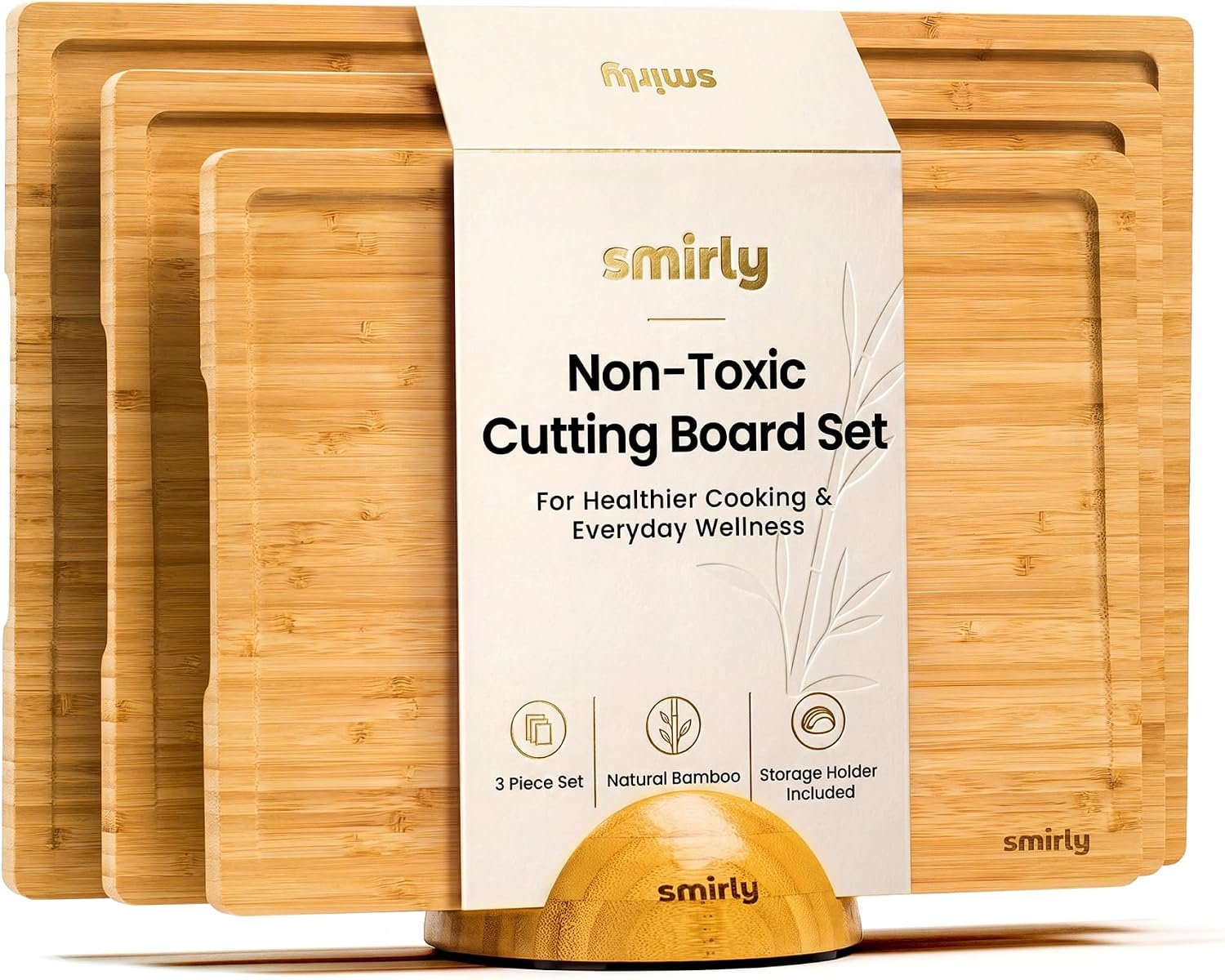
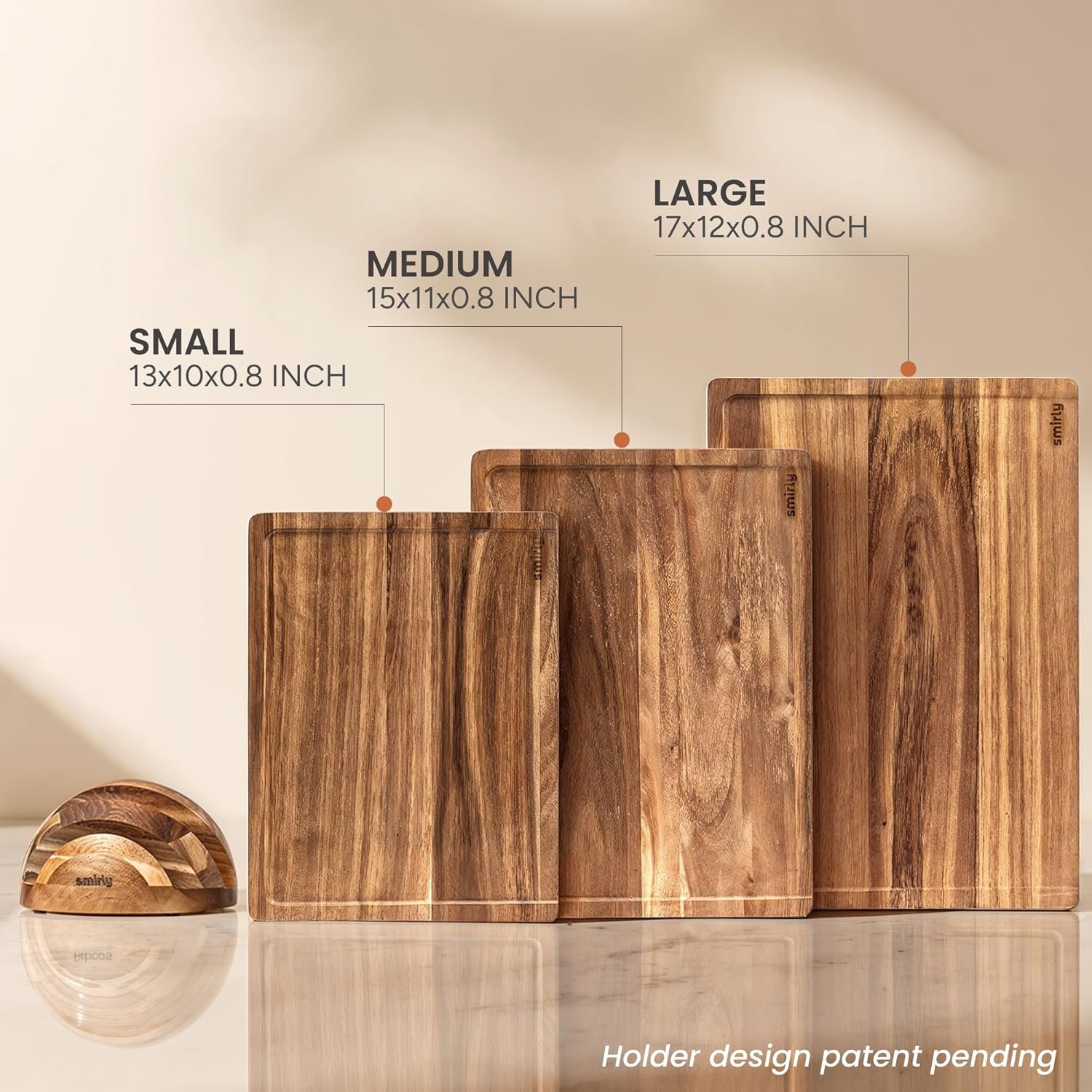
Material: Premium Acacia Wood | Pieces: 3 boards + holder
Sizes: Large 15″×11″, Medium 13″×11″, Small 11″×9″
Thickness: 0.4″ | Finish: Natural oil | Care: Hand wash only
Non-toxic: Yes | Non-slip: Yes | Dishwasher Safe: No
What’s in the Set
Three boards in a graduated size system, plus a dedicated holder that keeps all three stored upright and organized on your counter:
- Large (15″×11″) — the primary meat and chicken prep surface. Wide enough for chicken breasts, thighs, pork chops, and standard steaks without ingredients overhanging the edge
- Medium (13″×11″) — ideal for vegetables, fruit, and lighter prep tasks; also doubles as a serving board for cheese and charcuterie
- Small (11″×9″) — herbs, garlic, bread, garnishes, and quick single-ingredient tasks
The included holder is one of the most practical things about this set. It keeps all three boards standing upright between uses, which does two important things: it helps the boards dry completely after washing (critical for boards used with raw meat), and it keeps the kitchen counter organized so each board is visible and easy to grab. No more stacking boards flat in a drawer where they never fully dry and you’re always pulling out the wrong one.

Why Acacia Wood Works Well for Meat and Chicken
Acacia is one of the better natural wood choices specifically for raw meat prep, and it’s worth understanding why — not just taking it on marketing faith.
It’s a dense, hard hardwood. Acacia sits at roughly 1,750 lbf on the Janka hardness scale — harder than maple, significantly harder than rubber wood or pine. That density means knife marks are shallower and less frequent than on softer boards. Fewer deep grooves means fewer places for bacteria from raw meat juices to hide between washes. This matters more than most buyers realize when a board is used for chicken multiple times a week.
It’s naturally resistant to warping and cracking. Acacia has a tight, interlocking grain structure that resists the dimensional changes caused by moisture exposure. Boards used for raw meat get wet every time you wash them — a wood that warps or splits under that routine doesn’t stay safe or usable for long. SMIRLY’s acacia boards are specifically built to resist bending and cracking with regular use, which real buyer feedback after weeks of daily use backs up.
It doesn’t strip knife edges. One of the overlooked benefits of a quality hardwood over cheap plastic for everyday meat prep is that the surface is firm but not glass-hard. Your knives make contact with wood fiber, not unyielding plastic or ceramic. Reviewers consistently mention that their knives stay sharper longer after switching from plastic boards to these acacia ones — a practical daily benefit that adds up over time.
The natural grain is non-toxic and food-safe. The SMIRLY acacia boards are finished with a food-grade oil and are completely free of BPA, toxic adhesives, and synthetic coatings. When you’re prepping raw chicken directly on the surface, you don’t want to be second-guessing what’s in the board material. Acacia wood with a natural oil finish is about as clean and straightforward as a cutting board material gets.
Performance for Everyday Meal Prep
Raw chicken and poultry: The large 15″×11″ board gives you the surface area to work comfortably with whole chicken breasts, bone-in thighs, and full tenders without the protein crowding the edge. The ergonomic handle makes it easy to lift and transfer the board to the sink immediately after chicken prep — an important habit for food safety that a board without a handle makes surprisingly awkward. The smooth acacia surface wipes clean quickly and doesn’t hold on to raw chicken residue the way older, deeply grooved boards do.
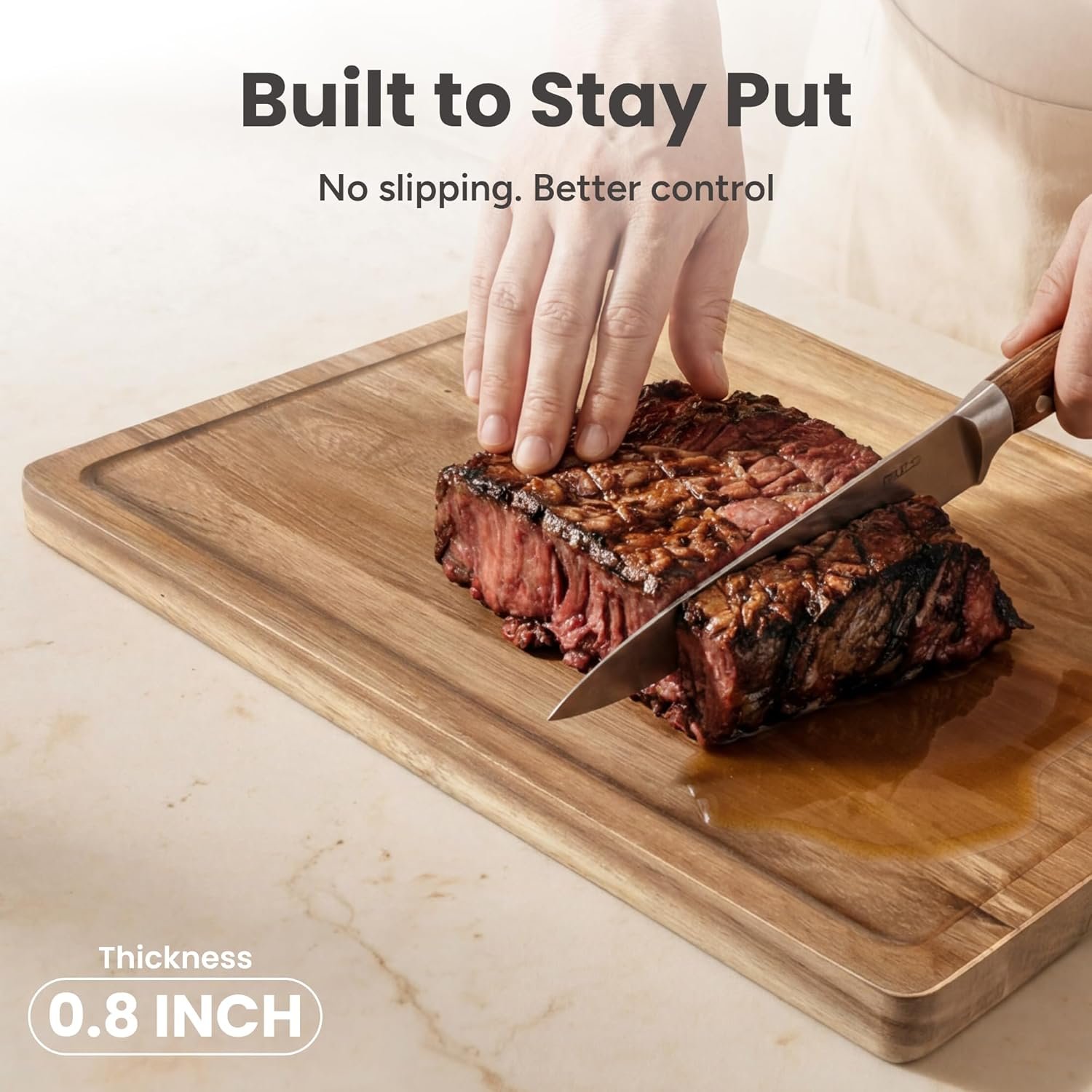
Steak and red meat: Dense hardwood handles the pressure of working through tougher cuts without the board sliding across the counter. The non-slip design keeps the board stable while you’re trimming fat, slicing against the grain, or working through thicker cuts that require real downward force.
Vegetables and everyday prep: The medium board handles the majority of vegetable prep work — peppers, onions, zucchini, tomatoes, carrots — with enough surface to work quickly without ingredients rolling off. Having a separate board for produce after handling raw meat isn’t just good practice; with the three-board system and holder, it becomes the natural, default routine because each board has its own dedicated spot.
Charcuterie and serving: Flip any board over or bring it to the table as-is — the natural acacia grain is attractive enough to serve on directly. Buyers regularly use the medium and large boards as impromptu charcuterie boards for entertaining, which makes this set genuinely multi-purpose rather than just a kitchen-only tool. The warm brown tones of acacia wood photograph well and present beautifully on a table.

Kitchen Organization — The Holder Changes Everything
This is the part of the set that gets underestimated until you actually have it in your kitchen.
The vertical holder keeps all three boards upright and separated on the counter. It sounds like a minor convenience — but the practical impact on daily kitchen organization is real. You always know where each board is. You can pull the right size for the task in one move. The boards dry properly between uses because air circulates around all sides when they’re stored upright. And the countertop stays clear because the boards have a home instead of being stacked flat or leaned against the backsplash.
For households with limited counter space — small apartments, compact galley kitchens, shared spaces — the holder is especially valuable. The entire 3-board set takes up roughly the same counter footprint as a single large flat board, while giving you three dedicated cutting surfaces.
Buyers who’ve switched from plastic boards specifically mention the holder as one of their favorite features: the organized, visible storage makes it easier to maintain the habit of using separate boards for different foods, which is the core food safety practice this set is built around.

Cleaning and Maintenance
After every use with raw meat or chicken:
- Wash immediately with warm soapy water — don’t let raw juices dry on the surface
- Rinse thoroughly and dry upright in the holder immediately — never leave flat while wet
- For extra sanitizing after raw poultry: wipe with a diluted white vinegar solution, let sit two minutes, rinse clean
Regular maintenance (every 4–6 weeks):
- Apply a thin coat of food-safe mineral oil to all surfaces, including the edges
- Let it soak in for 2–3 hours, then wipe off the excess
- This keeps the acacia wood hydrated, prevents surface drying, and maintains the board’s natural beauty and resistance to cracking
What to avoid:
- Dishwasher — the heat and prolonged moisture will warp and crack the wood
- Soaking in water — same reason
- Leaving flat while wet — moisture trapped underneath causes warping and mold
The cleaning routine takes about two minutes per board. It’s not complicated, and the maintenance conditioning only needs to happen monthly. For buyers switching from plastic boards who want to avoid microplastics in their food prep, this trade-off — hand washing instead of dishwasher, occasional oiling — is considered well worth it by the majority of buyers who’ve made the switch.

What Real Buyers Are Saying
Buyers who’ve used this set for weeks of daily kitchen use consistently highlight a few themes across Amazon and retailer reviews:
Several mention ditching plastic boards specifically over concerns about microplastics ending up in food — and describe the SMIRLY acacia set as their go-to replacement that holds up to daily use without any of the problems they expected from wood boards.
The holder is consistently mentioned as a standout feature — multiple buyers describe how it makes the kitchen feel more organized and keeps the boards looking “beautiful on display” between uses.
The surface durability earns specific praise from buyers who’ve used the boards daily for weeks without seeing visible wear, warping, or splitting, which matches the acacia wood’s natural resistance properties.
One buyer specifically called out the lip around the board’s perimeter for catching liquids during meat prep, noting it as “amazing” for keeping the counter clean. Several others echo the ease of cleaning, describing the smooth acacia surface as significantly easier to wipe down than older plastic or softer wood boards they’d previously used.
Who This Set Is Best For
Buy the SMIRLY Acacia Wood Set if you:
- Cook regularly and want a natural hardwood board that handles meat and chicken prep without warping or cracking
- Want a three-board system that builds a natural, habit-forming food safety routine in your kitchen
- Are switching away from plastic boards and want a non-toxic, eco-friendly alternative
- Value kitchen organization — the holder is genuinely useful for small and large kitchens alike
- Want a set that pulls double duty as both a prep tool and an attractive serving/charcuterie board
- Are looking for a practical, beautifully presented kitchen gift for a housewarming, birthday, wedding, or holiday
Consider an alternative if you:
- Want a fully dishwasher-safe board — BPA-free plastic is the better call for that
- Need a board thicker than 0.4″ for heavy cleaver work or bone-in breakdown tasks
- Want maximum hygiene for very frequent raw meat use with minimal maintenance — titanium or composite boards require less care
Pros and Cons
Pros:
- Premium acacia hardwood — harder and more durable than bamboo or softwood boards
- Three graduated sizes cover every daily cutting task
- Included holder keeps boards upright, organized, and properly dried
- Non-toxic, food-safe, BPA-free natural wood finish
- Non-slip design stays stable during meat and chicken prep
- Ergonomic handles for safe, easy transport
- Dual-purpose: prep board and attractive charcuterie/serving board
- Eco-friendly sustainable wood — no synthetic coatings or plastic components
- Resists warping, bending, cracking with regular use
- Makes a genuinely impressive kitchen gift
Cons:
- Hand wash only — not dishwasher-safe
- Requires periodic oiling every 4–6 weeks
- 0.4″ thickness, while practical and lightweight, is thinner than heavy-duty butcher blocks
- Natural wood means each board has a unique grain — color and pattern will vary slightly
Buyer’s Guide: What Is the Best Chopping Board for Meat and Chicken?
Material Comparison for Raw Meat Prep
Acacia and hardwood boards (like the SMIRLY set) offer the best combination of knife-friendliness, durability, natural aesthetics, and non-toxic materials for everyday meat prep. The hardness resists deep grooves, the natural grain is food-safe, and with proper care they last for years. Hand washing is required.
Bamboo boards are harder than most softwoods, eco-friendly, and more moisture-resistant than untreated wood. Carbonized bamboo (like the Keechee boards) reduces moisture absorption further. Good for daily use with consistent hand-washing and drying. Also not dishwasher-safe.
BPA-free plastic boards are the most practical choice for dishwasher-first households. Non-porous, fully sanitizable in the dishwasher, and cheap enough to replace when deep knife grooves develop. Not as aesthetically pleasing and contributes to plastic waste over time.
Composite boards (like Epicurean’s wood fiber boards) split the difference — non-porous like plastic, more knife-friendly than plastic, and dishwasher-safe. A premium option with fewer material concerns than plastic.
Titanium boards deliver maximum hygiene — completely non-porous, scratch-resistant, odor-free, and dishwasher-safe. The safest material for raw meat prep, but harder on knife edges than wood.
Size Matters More Than Most Buyers Realize
A board that’s too small for the protein you’re working with creates real problems — meat hangs off the edge, juices run onto the counter, and knife control suffers. For raw chicken and standard meat cuts, the absolute minimum useful surface is around 13″×9″. The large board in the SMIRLY set at 15″×11″ gives a comfortable working room for everything from chicken thighs to full ribeyes.
The Case for a Dedicated Meat Board
Using a single board for everything — raw chicken, vegetables, bread, cheese — is one of the most common kitchen food safety mistakes. The USDA and FDA both recommend separate boards for raw proteins and ready-to-eat foods. The three-board system in the SMIRLY set (with a dedicated holder to make the habit automatic) is specifically designed to make this separation natural and easy to maintain.
Wood vs. Plastic: The Microplastic Question
A growing number of home cooks are switching from plastic cutting boards after research began linking plastic board use to microplastic contamination of food during prep. A 2023 study found that plastic cutting boards shed microplastic particles during regular knife use — a concern that doesn’t apply to natural hardwood or bamboo boards. For households actively trying to reduce plastic exposure in food prep, a natural wood set like the SMIRLY acacia boards is the practical alternative.
Frequently Asked Questions
What is the best chopping board for meat and chicken? For everyday home use, a dense hardwood or quality bamboo board in a dedicated size (minimum 14″×10″) is the best balance of knife safety, food safety, and durability. The SMIRLY Acacia Wood 3-piece set is a top pick because the large board gives proper working room for chicken and meat, the non-slip design keeps it stable during prep, and the three-board system naturally enforces dedicated-board food safety habits.
Is wood or plastic better for cutting raw chicken? Both are safe with proper cleaning. Plastic is non-porous and dishwasher-safe, making sanitizing faster and more thorough. Wood is knife-friendlier, non-toxic, and doesn’t contribute microplastics to food. For households that hand-wash diligently, wood is the better everyday choice. For households that rely on the dishwasher for thorough sanitizing, plastic is more practical.
Can you use an acacia wood board for raw meat every day? Yes, with proper care. Wash with hot soapy water immediately after every raw meat use, dry upright completely, and condition with food-safe mineral oil every few weeks. Following this routine, a quality acacia board like the SMIRLY set handles daily meat prep without warping, cracking, or developing hygiene problems.
How do you clean a wooden chopping board after cutting chicken? Wash immediately with hot soapy water and a brush — don’t let raw chicken juices dry on the surface. For extra sanitizing, wipe with a diluted white vinegar solution (1 part vinegar to 4 parts water), let sit for two minutes, then rinse clean with water. Dry upright immediately — never leave a wood board lying flat while wet.
Do wooden cutting boards harbor more bacteria than plastic? Research on this is more nuanced than the common assumption. Studies have found that while bacteria do soak into wood grain initially, they stop multiplying and eventually die, whereas bacteria in knife grooves on plastic boards can survive and multiply. A clean, well-maintained wooden board is no less safe than a plastic one for raw meat prep. The key variable is consistent, thorough cleaning after every use on both materials.
Is the SMIRLY acacia set good as a gift? Yes — it’s one of the most consistently well-received kitchen gift sets in its price range. The natural acacia wood looks premium, the three-board set with holder is immediately practical, and the dual-purpose design (prep and charcuterie serving) gives it everyday value beyond a single-use kitchen tool. It’s popular for housewarmings, weddings, birthdays, and holidays.
What size chopping board do I need for chicken? For comfortable chicken prep — trimming, slicing, portioning — a board that’s at least 14″×10″ gives you enough surface to work without the chicken crowding the edges. The large board in the SMIRLY set at 15″×11″ is well-suited for most everyday poultry and meat tasks.
Final Verdict
The SMIRLY Acacia Wood Cutting Board Set of 3 with Holder is the best chopping board for meat and chicken for home cooks who want a natural hardwood option that holds up to daily prep, keeps the kitchen organized, and looks good doing both.
The acacia wood is genuinely harder and more durable than bamboo or softwood alternatives. The three-board system with holder turns the food-safety habit of using separate boards for meat and produce into something that happens automatically rather than requiring deliberate effort. The dual prep-and-serving design makes this a set you use every day, not something that gets put away after a single task. And the eco-friendly, non-toxic materials make it a natural fit for households that are moving away from plastic in the kitchen.
Hand washing is required — that’s the one real ask this set makes of you. If you’re willing to do that, this is one of the best everyday cutting board investments available at its price point.
#Ad | Affiliate Disclosure: Buyer’s Guide Pro participates in the Amazon Associates program and may earn a commission on purchases made through links in this article. This does not affect the price you pay or our editorial recommendations.